
Vera Jenkins · 27 October 2026
Timezone Variations and Their Influence on Content Reach for Personal Websites
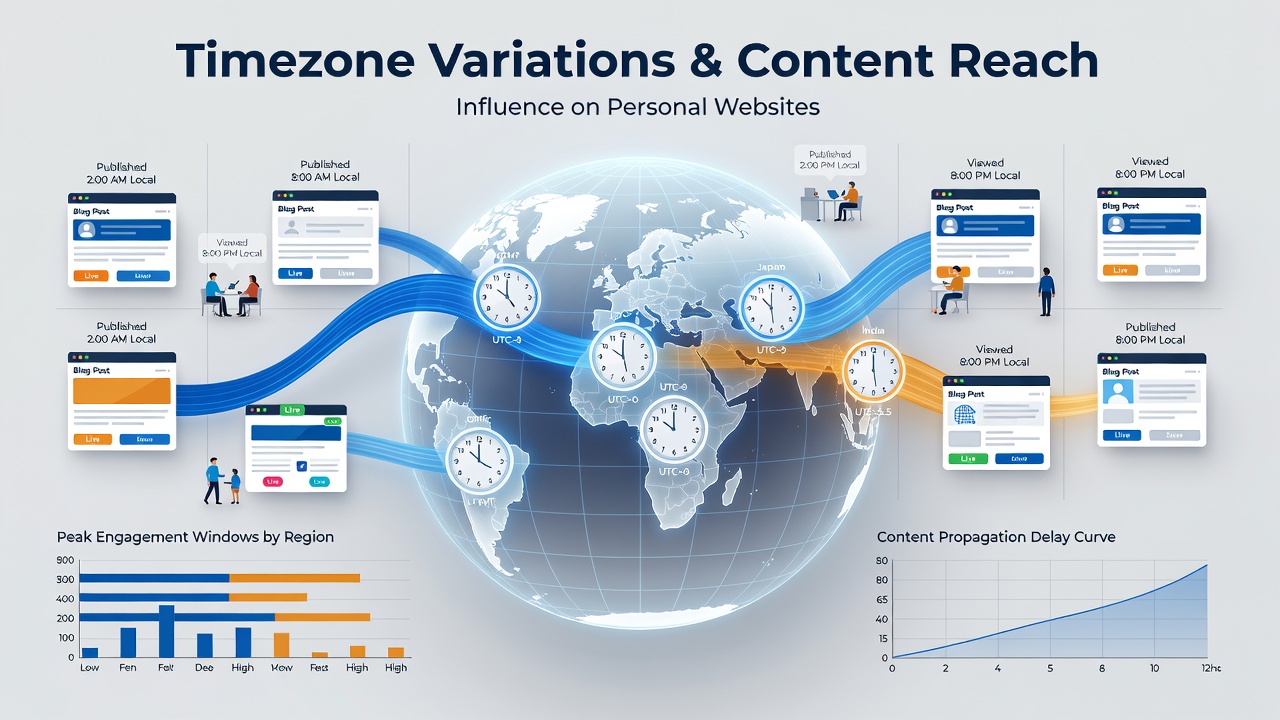
Timezone differences shape how content from personal websites reaches audiences across continents because publication times align with local activity patterns in each region. Observers note that a post published at 9 AM in one zone often lands during late evening hours elsewhere which reduces immediate visibility for readers in those areas. Data from global internet usage reports indicate that peak browsing periods cluster around early evening local times so mismatched schedules can lower initial engagement metrics for independent sites.
Core Mechanics of Timezone Impact
Personal websites publish articles without built-in geographic targeting in most cases which leaves reach dependent on when visitors check their feeds or search results. Researchers have tracked that audiences in the Americas engage more during their afternoon and evening hours while users in Asia show higher activity in morning slots relative to Coordinated Universal Time. When a site owner posts during their own daytime the content may appear in search indexes or aggregator feeds at suboptimal moments for distant readers and this timing mismatch compounds over multiple publications.
Studies from research institutions reveal consistent patterns where articles released outside target audience windows experience delayed clicks and shares. Those patterns hold across blog platforms and static sites alike because search engine crawlers and social distribution algorithms prioritize fresh content during high-traffic periods in each locale. Observers tracking independent publishers report that sites adjusting publication times to overlap with multiple zones record steadier traffic curves throughout a 24-hour cycle.
Regional Audience Distribution Effects
Content reach expands when publication schedules account for overlapping active hours across North America, Europe, and the Asia-Pacific corridor. Figures from digital analytics services show that personal sites covering topics with international appeal such as technology reviews or travel notes gain measurable additional visitors when posts appear between 2 PM and 8 PM UTC. This window captures evening readers on the US East Coast alongside morning users in East Asia while still serving European afternoon traffic.
Yet adjustments require attention to daylight saving transitions which shift offsets twice yearly in many countries. The National Institute of Standards and Technology maintains records of these changes and site operators who align schedules with updated offsets maintain consistent delivery windows. In October 2026 several regions will observe standard time resumption which shortens certain overlap periods and requires recalibration of automated posting tools.
Practical Scheduling Approaches
Automated tools now integrate timezone databases that convert a single publication time into equivalent local hours for chosen audience segments. Publishers who configure these systems report improved distribution because the content surfaces when readers are actively online rather than during sleep cycles. Data indicates that sites using such features achieve more uniform daily traffic distributions compared with those relying on manual single-zone posting.
One documented approach involves segmenting audiences by primary timezone clusters and testing staggered releases within a narrow UTC range. Analysts at academic centers studying digital media consumption found that staggered timing increased cumulative reach by spreading initial impressions across successive peak periods. This method avoids overwhelming any single audience group while allowing algorithmic promotion to build momentum gradually.
Measurement and Adjustment Practices
Analytics platforms provide timezone-filtered reports that let operators isolate traffic sources by visitor location. Those reports show clear correlations between publication UTC time and subsequent hourly visitor counts from each continent. Regular review of these datasets enables precise shifts in future schedules without altering content strategy. Observers note that personal sites maintaining logs of timezone-adjusted performance sustain steadier growth trajectories over multi-month periods.
Cross-referencing with broader industry data from sources such as Pew Research Center studies on online activity patterns supplies context for interpreting site-specific metrics. Additional benchmarks appear in reports issued by the International Bureau of Weights and Measures which tracks global time standards used in scheduling software. Integration of these references helps operators validate their internal observations against wider trends.
Conclusion
Timezone variations exert measurable influence on how personal website content reaches dispersed audiences through their effect on publication alignment with local activity peaks. Operators who incorporate accurate timezone data into scheduling routines and review location-filtered analytics achieve more consistent distribution across regions. Continued monitoring of offset changes and audience behavior patterns supports ongoing refinement of these practices for sustained reach.